TERRA
LAPUMI GUIDE · BREEDING & GENETICS
How breeding and inheritance work in Lapumi
Choose a pair with a purpose, compare their traits and make sense of the next generation.
By TerraCat Games · Updated
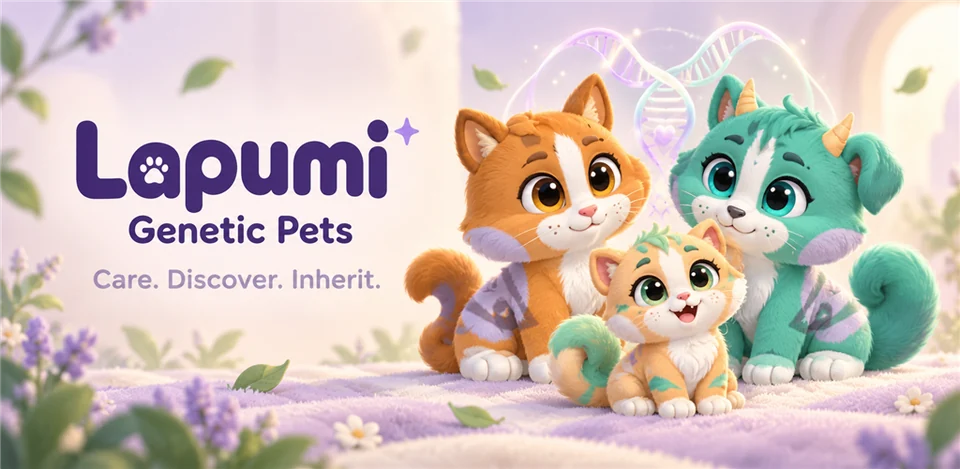
Choose parents for a discovery goal
Start with a trait you want to explore: a coat color, pattern, ear shape or another feature in your album. Compare potential parents in Breeding before committing to a pair.
Appearance gives you useful information, but it is not a complete record of everything a pet can pass on. Two similar-looking pets may carry different inherited variants. Two different-looking pets can share variants that are not currently visible.
What does a baby inherit?
A baby receives inherited variants from both parents. The combination influences which traits appear, alongside the game's other genetic systems. A hidden variant can travel through a family before it becomes visible in a later generation.
This is why a baby does not need to copy either parent, and why repeating a pair can produce different siblings. Matching appearances are not a promise of an identical baby.
Lapumi uses fictional game genetics. A pair's visible appearance alone is not enough to calculate a reliable probability for every possible result.
Readiness, space and the waiting time
The readiness indicator checks more than appearance. Both pets must be eligible and available, awake and sufficiently cared for. A pet that is away on an expedition, assigned to work or reserved in another activity may be unavailable. Follow the reason displayed by the game.
Living parents can normally breed during their first 30 days of life. Check each pet's remaining breeding time. A pet in the sanctuary is not an ordinary active breeding parent.
Own-pet breeding has no base coin fee, but it uses fullness, water, energy and cleanliness. Care for both parents afterwards. Paid partner offers have their own displayed price.
Expected babies occupy nursery places. Your pair's wait starts from a base of 15 minutes for young parents with no previous offspring, then increases with age and offspring history. The displayed timer is the guide for your pair.
Use research to answer a specific question
The Laboratory has research options for individual traits and broader panels. Research reveals information from the pet's existing genome; buying a research panel does not reroll that genome or guarantee a particular baby.
Begin with the question you want answered. An unexplored trait is unknown, not necessarily absent. Compare unlocked results with the parents' visible traits and the offspring you actually observe.
A useful breeding loop
- Pick one trait or collection gap to investigate.
- Compare two available parents and any research you have unlocked.
- Breed when both pets are ready and the nursery has space.
- Hatch the baby and compare its traits with the parents.
- Keep useful family information and choose the next pair from what you learned.
Nectar can affect mutation chances, but it does not promise a chosen trait or a special form. Treat each generation as new information, rather than expecting a guaranteed recipe from a pair's appearance.
New to the nursery? Follow the beginner guide. For unusual collection goals, read about rare and epic forms.
Try your next generation
Open Lapumi in your browser or on Telegram and put your discoveries into practice.